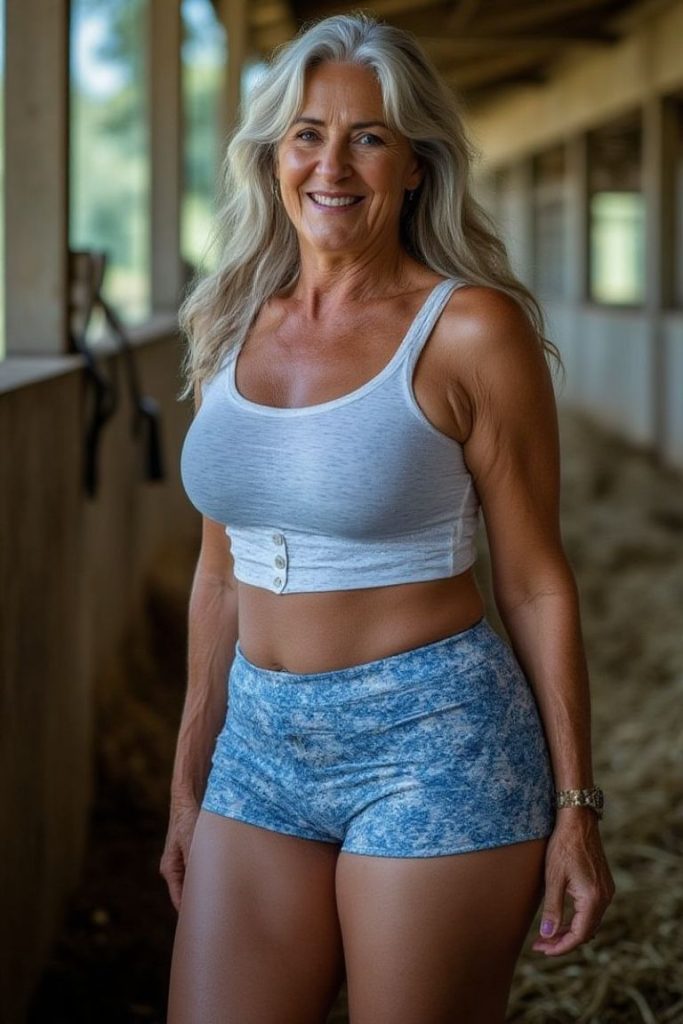
Most people in Willow Creek assumed Evelyn Harper was simply one of those naturally warm women—always smiling, always offering a kind word, always making others feel a little lighter just by standing near her. They said aging softened her. They said life mellowed her. They said she was born sweet and only got sweeter.
None of them knew the truth.
Her warmth wasn’t something she inherited. It was something she built—slowly, painfully, stubbornly—over decades.
In her thirties, Evelyn had been sharp-edged. Efficient. Focused. The kind of woman who kept lists for her lists, who scheduled phone calls like business meetings, who believed every problem had a solution as long as she pushed hard enough. She ran the household, her job, and half her friends’ crises with the precision of a military officer.
But life doesn’t respond to efficiency.
Her mother’s illness arrived without a plan. Her husband’s layoff happened without warning. Her daughter’s rebellious years tore through the house like a storm she couldn’t predict or control. One year after another, Evelyn found herself facing things she couldn’t out-organize, outwork, or outmaneuver.
She broke down more than once. Quietly. Alone.
Slowly, painfully, she learned the lesson no one wants:
Pressure doesn’t make a person stronger. Compassion does.
One winter morning, now in her early sixties, she stood outside the grocery store holding two bags of canned goods for the community pantry. Snow flurried around her coat collar. That’s when she noticed Henry Collins—a widower in the neighborhood—struggling to load heavy bags into his truck.
He didn’t ask for help. He never did. Henry was the kind of man who tried to shrink himself rather than burden anyone else.
“Hold on there,” Evelyn said, stepping forward without hesitation. “You’re about to throw your back out.”
Henry tried to wave her off. “No need, Evelyn. I’ve got it.”
She reached for the bag anyway, her tone steady, almost amused. “And I’ve got two good arms. Let me use them.”
He finally let her help. Not because he couldn’t do it, but because her presence made it feel safe to accept help—something he hadn’t felt in a long time.
As they lifted the last bag, Henry looked at her curiously. “How do you stay so… warm? Every year you seem kinder. Most folks get colder.”
Evelyn paused. A soft smile touched her face—not the cheerful one she used with strangers, but a slower, heavier one, like she was turning a page in her mind.
“Because I used to be the opposite,” she said. “Life taught me that being hard never protected me from anything. But being warm?” She brushed snow from her sleeves. “That saved me more than once.”
Henry didn’t fully understand, but something in her voice made him stand a little straighter, breathe a little easier.
People around Willow Creek kept noticing Evelyn’s warmth—her calm presence, her steady patience, the way she could listen without rushing to fix anything. They thought it was age working its magic, mellowing her like wine. But the real story was quieter, deeper.
Her warmth increased with age because she had lived long enough to recognize what truly mattered:
That people break easily.
That kindness costs little but repairs much.
That the strongest person in any room is often the one willing to be gentle.
And every year that passed, she chose gentleness again.
Not because the world was kind to her,
but because she refused to let the world make her anything else.