🌍 Massive 8.8 Earthquake Near Russia Triggers Widespread Tsunami Alerts in Pacific — U.S. West Coast, Hawaii, Japan on High Alert 🌊
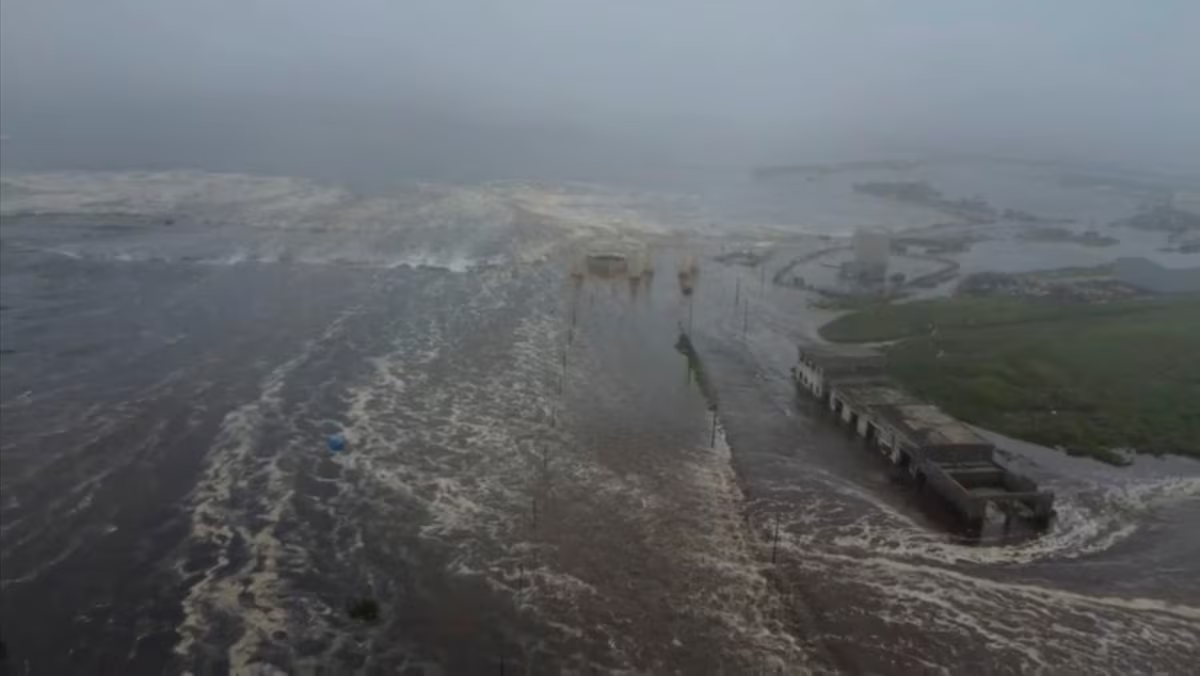
A powerful earthquake with a magnitude of 8.8 hit the Pacific Ocean near Russia’s Kamchatka Peninsula on Tuesday.
The quake caused tsunami warnings and advisories across the Pacific region, including for Hawaii, Alaska, California, Oregon, Washington, and several U.S. territories. Japan also issued coastal alerts.
This was one of the largest earthquakes recorded in the last 20 years, and emergency teams across the Pacific are rushing to prepare.
The earthquake occurred 85 miles (137 km) off the eastern shore of the Kamchatka Peninsula in eastern Russia.
The U.S. Geological Survey (USGS) said the quake was shallow — only about 12 miles (19 km) deep.
Shallow underwater quakes are more dangerous because they can push more water and trigger bigger tsunamis.
The quake was first reported as an 8.0, but after reviewing more data, experts increased it to 8.8, putting it in the same class as the 2010 Chile quake and the 2004 Indian Ocean disaster.
🔁 Aftershocks Still Rocking the Region
Following the main earthquake, at least two large aftershocks have hit the area — one measured at 6.3 and the other at 6.9. These aftershocks could keep coming for days or even weeks, according to seismologists.
🚨 Tsunami Warnings: Where and What’s Being Done
🗾 Kamchatka, Russia
Although Kamchatka is not densely populated, small towns and fishing villages along the coast are at serious risk.
Russian emergency teams have already sent out helicopters, military units, and rescue workers to help people evacuate low-lying areas. Sirens have sounded in major towns like Petropavlovsk-Kamchatsky.
United States: Multi-State Emergency Response
🏝️ Hawaii
- Hawaii is under a full tsunami warning.
- Sirensbegan sounding at6:10 p.m. local timeand are continuing every10 minutes.
- The first tsunami wave is expected to hit just after 7:15 p.m..
- Governor Josh Greenhas activated theEmergency Operations Centerand theJoint Information Center.
- All coastal residents have been told to move to higher ground immediately.
- If people cannot evacuate, they are advised to go to the fourth floor or higherof strong buildings.
- Experts say waves can wrap around the islands, making all shorelines vulnerable — even those facing away from the quake.
❄️ Alaska
- A tsunami warningis in effect for theAleutian Islands, the closest U.S. region to the quake’s center.
- People in towns like Dutch HarborandUnalaskaare being moved toemergency shelters or higher ground.
- Authorities warn that tsunami waves could hit the coast at any time, and more waves may come hours after the first.
🌉 California, Oregon, and Washington
- These states are under a tsunami advisory, which is less severe than a warning but still serious.
- Estimated wave arrival times:
- Northern California– 11:50 p.m. PT
- Los Angeles– 1:00 a.m. PT
- Cities like Santa Barbara, Crescent City, and Huntington Beachhaveclosed beaches and piers.
- Lifeguards and police are warning people to stay off the beach and out of the water.
- Even small tsunami waves can produce deadly rip currentsorpull people out to sea.
U.S. Territories: American Samoa and Guam
- Both territories are under tsunami advisories.
- Coastal warningshave been broadcast on local radio and television.
- People living near the ocean have been asked to gather emergency supplies and stay alert.
Japan Takes No Chances
Japan’s Meteorological Agency (JMA) issued tsunami warnings along its entire Pacific coastline, including:
- Hokkaido, where a wave up to1 meter(about 3.3 feet) is expected at10:00 a.m. local time.
- Honshu’s eastern shore, especially aroundSendai, an area devastated by the2011 tsunami, is also on high alert.
- Japan has shut down beach parks, closed ferry routes, and activated local disaster plans.
- Citizens have been told to stay away from beaches, riverbanks, and harbors.
- Trains have been slowed or canceled in coastal areas.
🧠 Why This Earthquake Could Be So Dangerous
A tsunami happens when a large undersea earthquake moves the seafloor and pushes water upward. This energy spreads in all directions across the ocean.
Experts say:
- The earthquake’s location and shallow depthmake a tsunamihighly likely.
- Multiple wavesare possible, oftenhours apart.
- The first wave is rarely the biggest.
- Coastal areas thousands of miles away can still be hit.
💡
U.S. National Weather Service says: “Don’t assume the danger is over after the first wave. Stay away from the shore for at least 12 hours.”
🧭 What You Should Do Now
If you are in any of the areas under warning or advisory:
✅ Evacuate now if you are near the coast and under a warning.
✅ Go to higher ground or at least four stories up in a concrete building.
✅ Do not go near the ocean to watch the waves — it can be deadly.
✅ Take a disaster bag: water, snacks, flashlight, charger, first aid, ID.
✅ Stay tuned to official alerts via NOAA, weather radios, or mobile apps.
.
📊 How Officials Are Responding
Across the Pacific region, emergency agencies are:
- Testing sirens, broadcasting emergency alerts, and preparing shelters.
- Working with the U.S. Coast Guard,FEMA, andlocal policeto manage evacuations.
- Airports and seaportsin many regions are under restricted access or temporary closure.
- Hospitals and rescue teamsare preparing for possible injuries or rescues.
⚠️ Still Developing: Stay Updated
This is a fast-moving emergency, and experts are still gathering data. Aftershocks or undersea landslides could trigger new waves or change the direction of the current tsunami.
Stay informed:
📡 Follow @USGS, @NWS, @HIEMA, @JMA and your local disaster office on social media
🌐 Visit www.tsunami.gov for real-time alerts and evacuation maps
📻 Keep a battery-powered radio nearby in case of power outages
🛑 This is a real threat. Take it seriously. If you’re near the coast, act now.